



 Artificial Intelligence
 Augmented & Virtual Reality
 Internet of Things
 Custom Software Development
 ERP Development
 Mobile Application Development
 Web Application Development
 Web Designing
 E-Commerce


How Web Applications Help Businesses in Dubai and the UAE Improve Efficiency and Growth
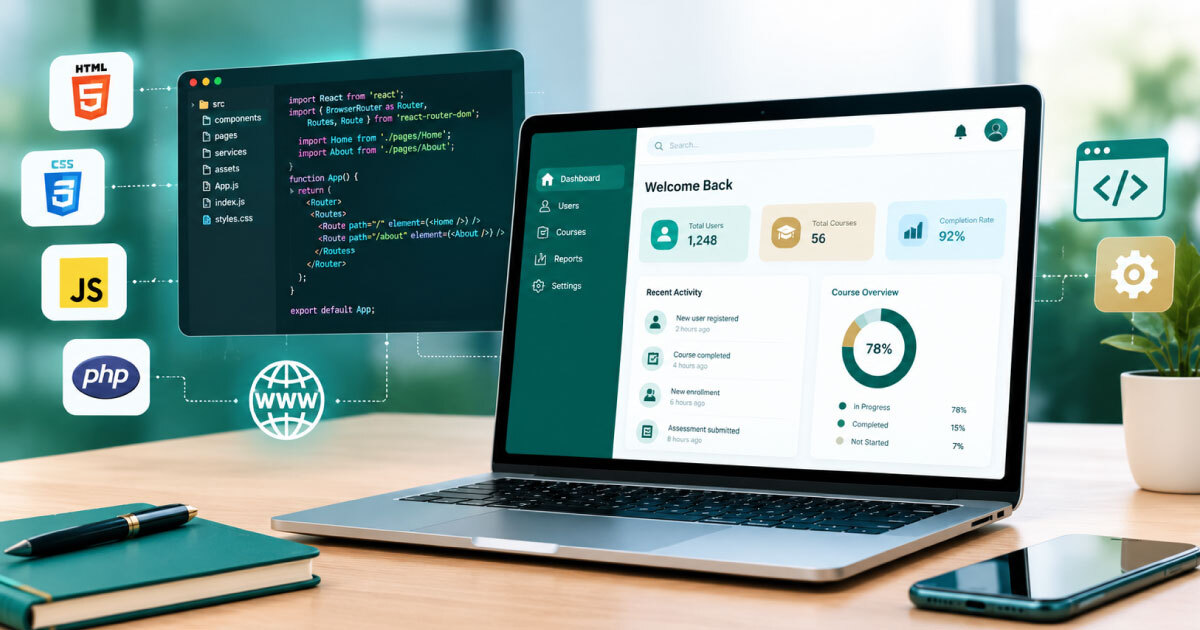
How Web Applications Help Businesses in Dubai and the UAE Improve Efficiency and Growth
Businesses across Dubai and the UAE increasingly rely on digital tools to manage operations, serve customers, and improve productivity. As organizations grow, managing business activities through spreadsheets, disconnected software, and manual processes can become complicated. Information may be scattered across different systems, communication can slow down, and teams may struggle to maintain accurate records.
Web applications provide a way to bring business processes, information, and user activities into a centralized digital environment. From customer portals and booking systems to inventory management platforms and enterprise applications, these solutions help organizations manage everyday operations through a web browser.
Understanding how web applications work, the types available, and the factors involved in developing them can help businesses make better technology decisions. Companies exploring a Web Application Development Company in Dubai should first understand how these applications can address specific operational challenges and support long-term business objectives.
What Is a Web Application?
A web application is a software application that users access through a web browser over a network or the internet. Unlike traditional desktop software that may require installation on individual computers, many web applications can be accessed from compatible devices through a browser.
Examples include online booking platforms, customer relationship management systems, employee portals, e-commerce management systems, project management tools, and cloud-based business dashboards.
A typical web application consists of several components:
- Frontend: The interface users interact with, including forms, dashboards, navigation, and visual elements.
- Backend: The server-side logic that processes requests, applies business rules, and manages application operations.
- Database: The system that stores and organizes information such as customer details, orders, transactions, and business records.
- APIs and integrations: Connections that allow the application to exchange information with other software and services.
- Security and access controls: Mechanisms that help protect information and determine what different users can access.
Businesses considering Web Application Development Services in Dubai should understand how these components work together to create a reliable and useful application.
Why Are Web Applications Important for Businesses in the UAE?
The value of a web application depends on the problems it solves. For one organization, the priority may be automating internal processes. For another, it may be improving customer access to services or giving management better visibility into business performance.
1. Centralized Business Information
When teams use separate systems to maintain customer information, sales records, employee details, and operational data, keeping everything consistent can be difficult.
A web application can centralize relevant information and provide authorized users with access to the records they need. This can reduce duplicate data entry, improve coordination, and make it easier to find current information.
For example, a distribution company may use a web-based platform to manage customers, orders, inventory, and delivery status within a connected workflow.
2. Automation of Repetitive Tasks
Manual tasks such as preparing reports, assigning requests, updating records, sending notifications, and approving submissions can consume valuable working time.
Business applications can automate selected activities based on defined rules. A system might notify a manager when an approval is required, update an order status after a transaction, or generate a report from recorded information.
The objective is not to automate every process indiscriminately. Businesses should identify repetitive activities where automation can reduce errors, improve consistency, and free employees to focus on more valuable work.
3. Better Access for Distributed Teams
Web applications can support employees, customers, suppliers, and business partners who need to access information from different locations. Depending on the application's design and security requirements, users may be able to work through supported desktop and mobile browsers.
For businesses operating across Dubai, Abu Dhabi, and other emirates, this can help teams access shared information without relying entirely on local files or manual exchanges.
4. Improved Customer Experience
Customers increasingly expect convenient ways to access services, submit requests, track orders, book appointments, and manage their accounts.
A well-designed web application can provide these capabilities through a consistent interface. Customers may be able to view their information, complete transactions, receive updates, and find relevant documents without contacting support for every request.
These improvements depend on usability, system reliability, accessibility, and the relevance of the features provided.
Common Types of Web Applications Used by Businesses
Web applications serve different purposes depending on an organization's industry, workflows, and customers.
Customer Relationship Management Applications
Customer relationship management (CRM) applications help businesses organize customer details, sales opportunities, communications, follow-ups, and service requests.
A CRM application can provide teams with a shared view of customer interactions and help managers monitor sales activities. Businesses may also connect the application with email platforms, marketing tools, and reporting systems where appropriate.
Inventory and Order Management Applications
Inventory applications help organizations monitor stock levels, product movement, purchase orders, and warehouse activities.
When connected to order management, these systems can help teams follow an order from placement through processing and fulfilment. Retailers, distributors, wholesalers, and manufacturers may benefit from having these activities connected instead of maintaining separate records.
Employee and Internal Business Portals
Employee portals can provide access to internal announcements, policies, forms, requests, documents, and selected HR functions.
Depending on the requirements, a portal may support leave requests, approval workflows, employee onboarding, and department-specific information. Access permissions are important because employees and managers may need different levels of visibility.
Customer and Supplier Portals
A customer portal may allow users to manage accounts, check order status, download documents, or submit support requests. Supplier portals can support purchase order visibility, document submission, and communication between procurement teams and vendors.
A business that needs these capabilities may explore a Web Portal Development Company in UAE to understand how a portal can fit into its existing operations.
Booking and Appointment Applications
Booking applications allow users to view availability, schedule appointments, receive confirmations, and manage changes. Businesses may use them for consultations, service appointments, training sessions, equipment reservations, or facility bookings.
Useful features include calendar management, automated notifications, user accounts, and integration with payment systems where necessary.
SaaS Applications
Software as a Service (SaaS) applications deliver software through an online service model, commonly using subscriptions or other recurring payment arrangements.
A SaaS product may support multiple customer organizations, user accounts, configurable features, billing workflows, and subscription management. Building one requires planning for tenant separation, security, availability, performance, and ongoing updates.
Organizations evaluating a SaaS application development provider should consider both the initial product requirements and the operational responsibilities involved in maintaining the service.
Custom Web Applications vs Ready-Made Software
Businesses often need to decide whether to purchase an existing software product or develop an application tailored to their operations.
Ready-made software can be appropriate when its existing features match the business's requirements. It may offer a quicker implementation path and established functionality.
Custom development may be useful when an organization has specialized workflows, unique user roles, specific integration requirements, or operational processes that generic software does not support adequately.
A custom application can be designed around defined business rules, but it also requires planning for development, testing, security, hosting, maintenance, and future enhancements.
Businesses researching Custom Web Application Development in the UAE should compare both approaches based on functional fit, integration needs, total ownership costs, implementation time, and long-term flexibility.
The decision should be based on the actual business problem rather than assuming that custom development is always the better option.
How Web Application Development Works
A structured development process helps organizations turn business requirements into a usable and maintainable application.
1. Requirement Analysis
The process begins by identifying the users, business objectives, existing workflows, challenges, and expected outcomes.
Stakeholders should clarify which tasks the application must support, what information it needs to manage, and which systems it must connect with. Clear requirements reduce ambiguity during design and development.
2. Planning and Architecture
The next stage involves defining the application's structure, technical approach, data model, user roles, integrations, and deployment requirements.
Architecture decisions should account for the expected number of users, data volume, security requirements, and potential future expansion.
3. UI and UX Design
User interface (UI) and user experience (UX) design determine how people navigate and interact with the application.
Designers organize information, create page layouts, plan workflows, and test whether users can complete common tasks without unnecessary complexity. Clear forms, accessible navigation, helpful error messages, and responsive layouts all contribute to usability.
4. Frontend and Backend Development
Frontend development creates the user-facing interface. Backend development implements application logic, data processing, authentication, permissions, and connections to databases or external services.
Full-stack development covers work across both frontend and backend components. The technology stack should be selected based on maintainability, security, team expertise, integration requirements, and performance—not simply because a technology is popular.
5. Testing and Quality Assurance
Before launch, the application should be tested to identify defects and verify that its features behave as expected.
Testing may cover functional correctness, usability, browser compatibility, mobile responsiveness, performance, security, access permissions, and integrations. User acceptance testing can help confirm that the application supports real business workflows.
6. Deployment and Maintenance
Deployment makes the application available to its intended users. The work continues after launch through monitoring, bug fixes, security updates, backups, performance improvements, and feature enhancements.
Businesses planning Web Application Design and Development in Dubai should include maintenance and support in their project planning rather than treating launch as the end of the development process.
Security Considerations for Web Applications
Web applications may process customer information, employee records, financial data, business documents, or confidential operational details. Security therefore needs to be considered throughout development.
- Authentication: Verify the identity of users before granting access.
- Role-based access control: Restrict features and information according to each user's responsibilities.
- Data protection: Use appropriate encryption and secure communication methods.
- Input validation: Check submitted information to help prevent common application vulnerabilities.
- Secure configuration: Protect application settings, credentials, servers, and connected services.
- Monitoring and logging: Record relevant activity and investigate unusual events.
- Backups and recovery: Maintain appropriate backups and test recovery procedures.
- Regular updates: Address software vulnerabilities and keep dependencies maintained.
Security controls should reflect the type of data being processed and the legal and regulatory requirements applicable to the business.
Building Web Applications That Can Scale
An application that works well for a small team may experience challenges as the number of users, transactions, integrations, or records increases.
Scalability means designing and operating the application so that it can accommodate changing demand without unacceptable deterioration in performance or reliability.
- Efficient database queries and appropriate data structures.
- Application architecture suited to expected workloads.
- Caching and other performance improvements where appropriate.
- Infrastructure that can be expanded when required.
- Monitoring to identify bottlenecks.
- Testing under realistic usage conditions.
- Maintainable code that supports future enhancements.
Scalable Web Application Development in the UAE should begin with realistic business requirements. Not every application needs a complex distributed architecture from the beginning; the design should match the expected workload and provide a practical path for growth.
Web Application Integration With Existing Business Systems
Many organizations already use accounting software, CRM platforms, ERP systems, payment gateways, email services, or third-party business tools.
A new web application may need to exchange information with these systems to avoid duplicate work and disconnected records.
Integration can involve APIs, webhooks, scheduled data transfers, or other supported mechanisms. For example, an order management application might send transaction information to an accounting system, while a customer portal may retrieve relevant information from a CRM platform.
Before implementation, businesses should evaluate data formats, authentication methods, synchronization frequency, error handling, system limitations, and ownership of shared information.
Good integration planning also considers what happens when a connected service is unavailable or returns incomplete information.
Web Applications for Enterprise Operations
Larger organizations may require applications that support multiple departments, complex approval processes, large user groups, and connections to existing enterprise systems.
Enterprise applications can bring together activities such as procurement, project management, reporting, customer service, employee workflows, and inventory operations.
Enterprise Web Application Development in the UAE may involve additional considerations, including centralized identity management, audit trails, department-level permissions, data governance, reporting requirements, and integrations with established enterprise platforms.
The application should reflect how the organization actually operates. Mapping responsibilities and approval paths before development helps avoid unnecessary complexity and conflicting workflows.
How to Choose a Web Application Development Company
Choosing a development partner requires evaluating more than its technology stack or portfolio presentation.
Businesses comparing a Web Application Development Company in UAE should consider the following factors.
Understanding of business requirements: The development team should be able to understand the problem, ask relevant questions, and translate business needs into clear functional requirements.
Relevant technical experience: Look for experience with the types of applications, integrations, data structures, and user workflows involved in the project.
Design and usability: The proposed solution should prioritize user needs, accessible interfaces, and straightforward workflows.
Security practices: Ask how authentication, permissions, data protection, testing, updates, and incident handling will be addressed.
Communication and project management: Agree on deliverables, milestones, responsibilities, review cycles, and how changes will be managed.
Maintenance and support: Clarify how defects, updates, monitoring, backups, and future enhancements will be handled after launch.
Businesses in Abu Dhabi may also compare providers in Dubai or elsewhere in the UAE. The most suitable choice depends on project fit, technical capability, communication, service arrangements, and the organization's requirements—not location alone.
Common Mistakes to Avoid
Web application projects can face difficulties when business needs and technical decisions are not aligned.
- Starting development without clearly defined requirements.
- Adding too many features before validating the core workflow.
- Overlooking security and user permissions until late in the project.
- Ignoring the needs of mobile and tablet users.
- Selecting technologies without considering long-term maintenance.
- Failing to test integrations and realistic user scenarios.
- Underestimating hosting, support, and ongoing maintenance.
- Launching without a plan to collect feedback and measure results.
A phased approach can help organizations validate the most important features first, gather feedback, and prioritize further improvements based on actual usage.
How to Measure the Success of a Web Application
A successful application should produce measurable improvements related to its original purpose.
Businesses can establish baseline measurements before launch and compare them with results after implementation.
- Time required to complete a business task.
- Number of manual steps eliminated.
- Data entry errors or duplicate records.
- Customer request resolution time.
- Application availability and response time.
- User adoption and task completion rates.
- Processing time for orders, approvals, or requests.
- Maintenance effort and support requests.
The appropriate metrics depend on the application. A customer portal may be evaluated through self-service usage and request completion, while an internal workflow application may be measured through processing time and error reduction.
Regularly reviewing these indicators helps organizations determine whether the application is delivering its intended business value.
The Future of Web Application Development in the UAE
Web applications continue to evolve as organizations adopt cloud infrastructure, automation, AI-enabled features, connected business systems, and more flexible working practices.
AI may support selected functions such as document classification, information retrieval, customer support, forecasting, and workflow assistance. However, these capabilities need appropriate data controls, validation, and human oversight where decisions have significant consequences.
Cloud-based infrastructure can provide flexible deployment options, while APIs can help applications exchange information with other services. Progressive web technologies may also support selected app-like experiences through compatible browsers and devices.
For businesses in Dubai and across the UAE, the priority should be to evaluate these developments based on practical needs. New technology is most valuable when it improves a workflow, addresses a customer problem, or supports a measurable business objective.
Conclusion
Web applications help businesses organize information, automate repetitive work, improve customer access, and connect important business processes. From CRM systems and employee portals to SaaS products and enterprise platforms, their value depends on how well they address real operational needs.
Before starting a project, organizations should define their requirements, evaluate custom and ready-made options, plan for security and integration, and consider maintenance from the beginning. Clear objectives and a structured development process can help reduce implementation risks and create a more sustainable solution.
For businesses in Dubai and across the UAE, understanding these fundamentals is an important first step toward making informed decisions about web application development and digital transformation. Learn more about our web application development services and how they may support your business requirements.