



 Artificial Intelligence
 Augmented & Virtual Reality
 Internet of Things
 Custom Software Development
 ERP Development
 Mobile Application Development
 Web Application Development
 Web Designing
 E-Commerce


How AR and VR Development Is Transforming Businesses in Dubai and the UAE
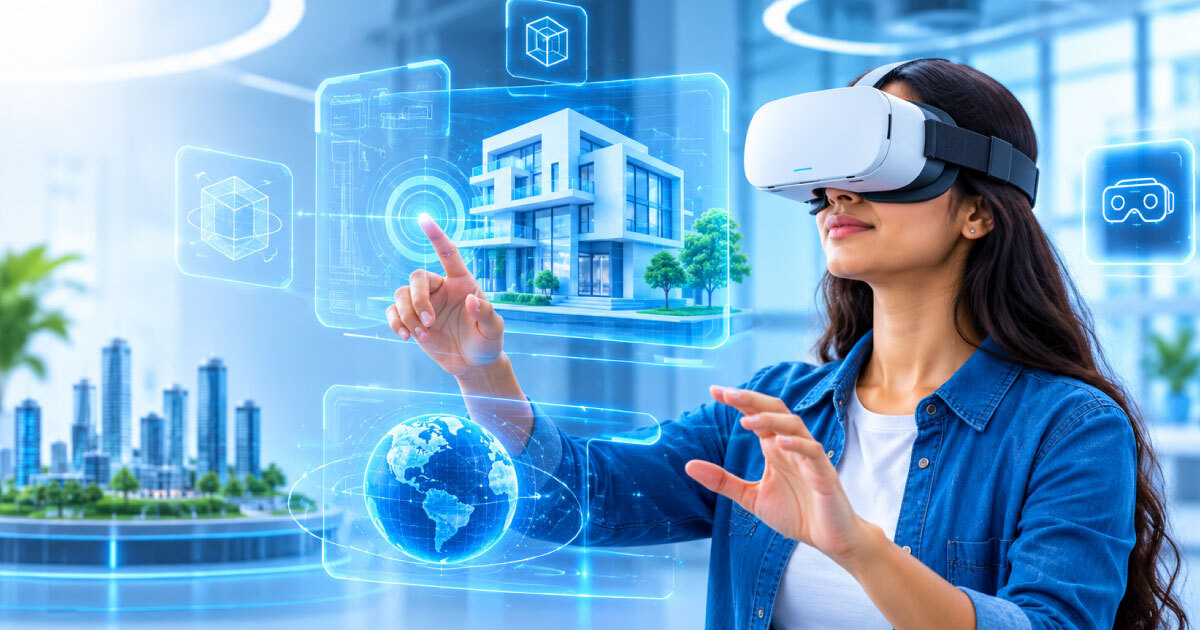
How AR and VR Development Is Transforming Businesses in Dubai and the UAE
Augmented Reality (AR) and Virtual Reality (VR) are changing how businesses present products, train employees, communicate ideas, and deliver more interactive customer experiences. Across Dubai and the UAE, organizations are exploring immersive technologies to improve operational efficiency, simplify complex information, and create engaging digital experiences.
From virtual property tours and interactive product demonstrations to employee training simulations and 3D visualization, AR and VR offer practical applications beyond entertainment. Understanding how these technologies work, where they deliver value, and what businesses should consider before implementation can help organizations make informed technology decisions.
What Are Augmented Reality and Virtual Reality?
Augmented Reality and Virtual Reality are immersive technologies, but they provide different experiences.
Augmented Reality (AR) adds digital elements to the real-world environment. Users can view 3D models, product information, animations, or interactive objects through compatible smartphones, tablets, or AR-enabled devices.
Virtual Reality (VR) creates a computer-generated environment that users can explore through compatible VR headsets. It allows people to experience simulated locations, practice tasks, and interact with virtual objects without being physically present in the environment being represented.
For businesses evaluating an AR VR Development Company in Dubai, understanding these differences is an important first step. The right technology depends on the intended application, user experience, available devices, and business objectives.
How AR and VR Work Together in Modern Business
AR and VR can support different stages of a business process. AR helps users interact with digital information while remaining aware of their physical surroundings, whereas VR enables immersive simulations in controlled virtual environments.
For example, a real estate company can use AR to help customers visualize furniture within a property, while VR can provide a virtual walkthrough before the property is completed. A manufacturing company can use AR to display equipment instructions and VR to train workers in a simulated industrial environment.
These applications demonstrate why businesses increasingly explore AR VR Development Services in Dubai and other UAE business hubs.
Key Business Applications of AR and VR in the UAE
1. Real Estate and Property Visualization
Real estate companies can use immersive technology to present properties to potential buyers and investors. Virtual tours allow customers to explore layouts, rooms, and property features remotely.
AR can help customers visualize interior designs, furniture placement, and proposed modifications within an existing space. Meanwhile, VR can simulate a complete property experience, including developments that are still under construction.
Businesses exploring 3D Visualization Services may also consider interactive architectural models and realistic property walkthroughs as part of their digital presentation strategy.
2. Retail and E-Commerce
Retailers can use AR to help customers understand how products may look in their own environments. Furniture visualization, virtual product previews, and interactive demonstrations can make online shopping more informative.
For example, a customer shopping for furniture may use an AR-enabled application to preview a sofa in a living room before making a purchase. Similarly, product manufacturers can create interactive 3D demonstrations to explain features that are difficult to communicate through static photographs.
These experiences can support more informed purchasing decisions when they are designed around actual customer needs.
3. Education and Employee Training
Training organizations and corporate learning teams can use VR to create simulated environments for practical learning. Employees can practice procedures, explore equipment, and respond to simulated situations without immediately facing the risks associated with real-world operations.
AR can complement these experiences by displaying instructions, labels, and visual guidance during practical tasks.
Organizations considering an AR VR Development Company in UAE may explore these applications for technical training, workplace safety, equipment familiarization, and skills development.
The effectiveness of an immersive training program depends on the quality of the learning design, the realism of the simulation, and how learner performance is assessed.
4. Manufacturing and Industrial Operations
Industrial organizations can explore AR to provide visual instructions for assembly, maintenance, and equipment inspection. Digital overlays can help technicians identify components, follow procedures, and access relevant technical information.
VR can support simulated equipment training, safety exercises, and preparation for complex industrial tasks.
However, implementing these solutions requires careful consideration of equipment compatibility, environmental conditions, data integration, and the accuracy of digital models.
5. Healthcare and Medical Education
Healthcare organizations can use VR simulations to support medical education, procedural practice, and patient awareness. AR may assist with visual explanations of anatomy or provide supplementary information in selected clinical and educational workflows.
These applications require appropriate validation, privacy safeguards, and compliance with relevant healthcare requirements. Immersive technology should support qualified professionals rather than replace clinical judgment.
Understanding AR, VR, MR, and XR
Businesses researching immersive technology may encounter several related terms.
- Augmented Reality (AR): Adds digital information to the real-world environment.
- Virtual Reality (VR): Creates a computer-generated environment for immersive interaction.
- Mixed Reality (MR): Combines physical and digital environments, allowing digital objects to interact with the real world in supported systems.
- Extended Reality (XR): An umbrella term covering AR, VR, MR, and related immersive experiences.
A Mixed Reality Development Company in Dubai may work on applications that combine physical spaces with interactive digital objects. The appropriate approach depends on the required level of immersion, device capabilities, and the interactions users need to perform.
What Are AR/VR Development Services?
AR VR Development Services in Dubai can cover several stages, from initial planning to deployment and maintenance.
Application and Experience Design
The development process begins by identifying the target audience, business problem, user journey, and intended outcome. Designers then plan how users will interact with digital objects and environments.
3D Modelling and Visualization
Many immersive applications require three-dimensional models of products, buildings, equipment, or environments. These assets must balance visual quality, technical accuracy, and performance on the target device.
AR Application Development
AR applications can use compatible smartphone cameras, sensors, and device capabilities to position digital content within a physical environment. Depending on the project, an AR App Development Company in Dubai may develop product visualization tools, interactive guides, or location-based experiences.
VR Application Development
VR applications can include virtual walkthroughs, training simulations, interactive demonstrations, and digital environments. A VR App Development Company in Dubai may need to account for headset compatibility, navigation, interaction methods, and user comfort.
Integration and Ongoing Support
Some solutions need to connect with existing websites, mobile applications, enterprise systems, product databases, or content management platforms. Testing, performance optimization, device compatibility, and ongoing updates are important parts of a sustainable implementation.
How to Choose the Right AR/VR Development Approach
Before engaging an AR VR Software Development Company, businesses should evaluate several factors.
1. Define the business objective
Identify whether the goal is to improve product visualization, reduce training risks, support maintenance, enhance customer engagement, or communicate complex information.
2. Identify the target users and devices
A mobile AR application may be more accessible for customers, while a VR headset may be appropriate for controlled training environments. Device selection affects development costs, accessibility, and user adoption.
3. Evaluate technical requirements
Consider 3D asset creation, application performance, integrations, data security, connectivity, and compatibility with existing systems.
4. Review scalability and maintenance
Determine how digital models, product information, training modules, and application features will be updated as business requirements change.
5. Measure business outcomes
Establish measurable objectives before deployment. Depending on the application, useful indicators may include task completion time, training assessment results, user engagement, product return rates, or customer satisfaction.
Choosing an AR VR Solutions Provider in the UAE requires assessing technical capabilities alongside the provider's understanding of the business problem.
Challenges Businesses Should Consider Before Adopting AR/VR
Although immersive technologies offer opportunities, they also present practical challenges.
- Development complexity: Interactive 3D environments and realistic simulations may require specialist skills and extensive testing.
- Device compatibility: Experiences must be designed for the intended devices, operating systems, and hardware capabilities.
- Performance requirements: Detailed graphics and complex interactions can affect loading times, responsiveness, and battery consumption.
- User adoption: Employees and customers need intuitive interfaces and appropriate guidance to use the technology effectively.
- Data protection: Applications using cameras, sensors, location information, or personal data must be designed with suitable privacy and security controls.
- Content maintenance: Product models, equipment information, and virtual environments may need regular updates to remain accurate.
Planning for these factors early helps businesses avoid investing in experiences that are visually impressive but difficult to maintain or poorly aligned with operational needs.
The Future of Immersive Technology in the UAE
As digital transformation continues across industries, immersive technology may become increasingly useful for product communication, workforce development, remote collaboration, and interactive customer experiences.
Advances in mobile hardware, real-time 3D rendering, artificial intelligence, and spatial computing are creating new possibilities for how people interact with digital information.
However, successful adoption depends on selecting applications that solve real problems. Businesses do not necessarily need the most complex immersive experience; they need a solution that fits their users, budget, infrastructure, and measurable objectives.
Organizations exploring Immersive Technology Solutions in the UAE should therefore begin with a clearly defined use case and a practical implementation plan.
Conclusion
AR and VR are expanding the ways businesses can present products, train employees, visualize spaces, and communicate complex information. From property walkthroughs and retail product previews to industrial simulations and interactive learning, these technologies can support a wide range of business objectives.
Before selecting a development approach, organizations should assess their requirements, target devices, integration needs, security considerations, and expected outcomes. A well-planned implementation focuses on practical value rather than technology alone.
For businesses in Dubai and across the UAE, understanding these fundamentals is a useful starting point for deciding where immersive technology can contribute to their digital transformation strategy. Explore our AR/VR development services to learn more about potential solutions for your business.